MISRA C; Mastering the Coding Standard for Secure and Reliable Embedded Systems
MSRP:
Was:
Now:
(Inc. Tax)
MSRP:
Was:
Now:
USD215.43
(You save)
SKU:
UPC:
When you get access:
Course access is prepared after purchase and delivered via email
How you learn:
Self-paced • Lifetime updates
Your guarantee:
30-day money-back guarantee — no questions asked
Who trusts this:
Trusted by professionals in 160+ countries
Toolkit Included:
Includes a practical, ready-to-use toolkit with implementation templates, worksheets, checklists, and decision-support materials so you can apply what you learn immediately - no additional setup required.
MISRA C: Mastering the Coding Standard for Secure and Reliable Embedded Systems
MISRA C: Mastering the Coding Standard for Secure and Reliable Embedded Systems
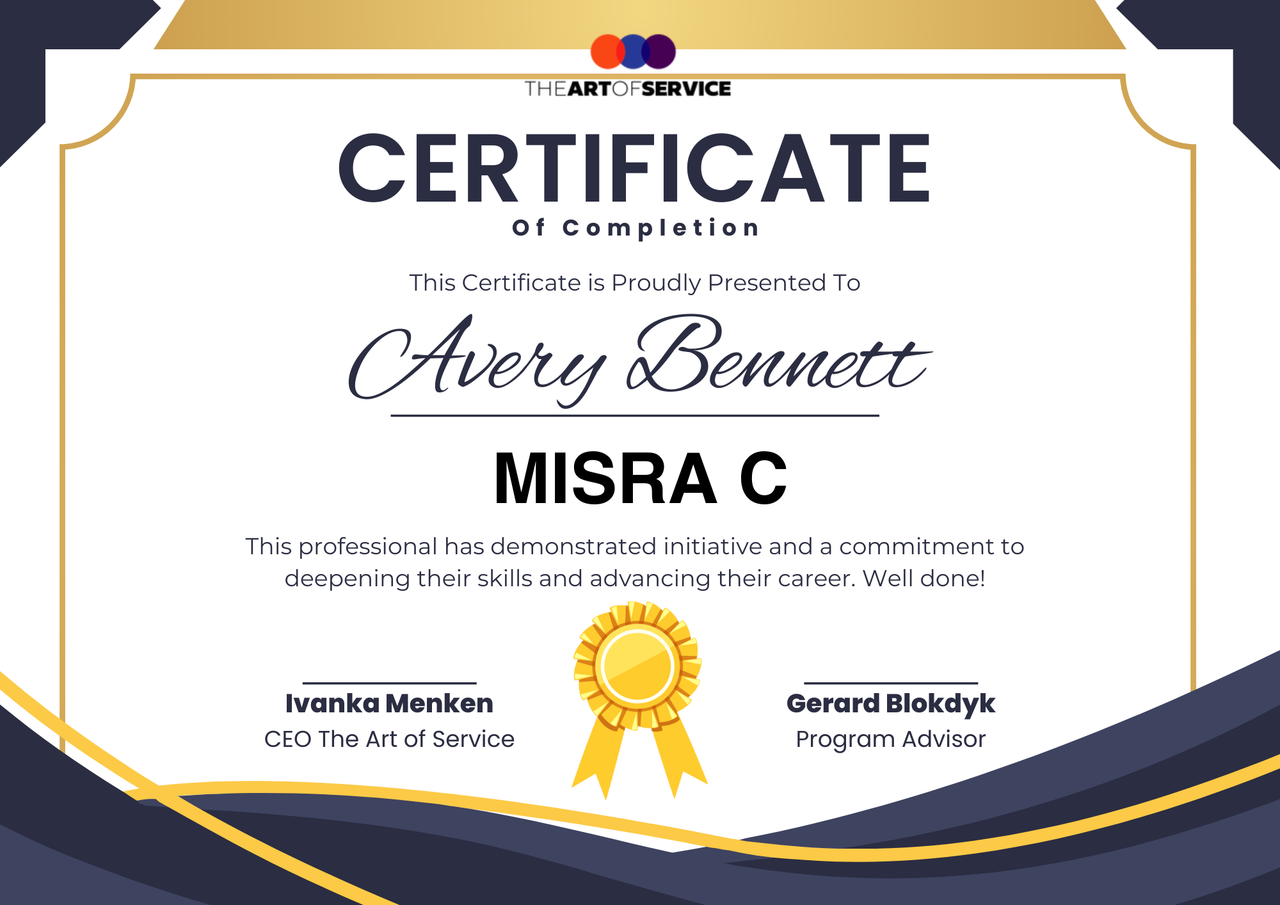
This comprehensive course will help you master the MISRA C coding standard, ensuring that your embedded systems are secure, reliable, and compliant with industry regulations. Upon completion of this course, participants will receive a certificate issued by The Art of Service.
Overview of automotive regulations (ISO 26262, etc.)
MISRA C compliance in automotive development
Ensuring safety and security in automotive systems
6.2 MISRA C and Aerospace Regulations
Overview of aerospace regulations (DO-178C, etc.)
MISRA C compliance in aerospace development
Ensuring safety and security in aerospace systems
Chapter 7: Conclusion and Next Steps
7.1 Summary of Key Concepts
Review of key MISRA C concepts and principles
Best practices for MISRA C development
Industry regulations and compliance
7.2 Next Steps and Future Directions
Future directions for MISRA C and embedded systems
Emerging trends and technologies
Continuing education and professional development
This course is designed to be interactive, engaging, comprehensive, personalized, up-to-date, practical, and focused on real-world applications. Our expert instructors will guide you through the course material, providing actionable insights, hands-on projects, and bite-sized lessons. You will have lifetime access to the course content, and you can track your progress through our user-friendly interface. Upon completion of the course, you will receive a certificate issued by The Art of Service. ,